Taste is knowledge. As Whit & Whipps (2000, p. 26) put it, taste, uniquely among the senses, dissolves its object into the body: “the object to be known in tasting becomes part of the knower in a sense of being swallowed and transformed.” This Busy Bee article is strictly no funny business. I hope you’re okay with that. (。>\\<)
Onward to my favourite meal in Berlin, it was at Café Frieda’s. I was plotting to eat here because the dishes I stalked obsessively online looked – to kindly put it – fucked. Duck liver and stuffed morels on toast glossed with duck jus and Armagnac-soaked plums; lobster with Szechuan peppercorns and strawberries; a mandarin gelato crowned with candied ginger and bitter orange skin. What’s so compelling about these combinations?
To me, these ingredients signal a willingness to play, linger in the tension and in the in-betweens – sweet and bitter, lush and puckering, earthy and electric. Here, cuisine becomes synonymous with high-stakes storytelling, where genre is bent just as textures and flavours are.
Recalling my opening line, at Café Frieda’s in Berlin – taste is the sense that educates. Taste speaks in acidic metaphors and tangy dialects. It’s a restaurant that knows flavour, and more radically, one that trusts the eater to know, too. It is, quite simply, a restaurant that treats food as an intellectual and emotional endeavour – something Sydney is still too afraid, or too stunted, to do.
Enough of that nerd shit though, here’s what I ate:
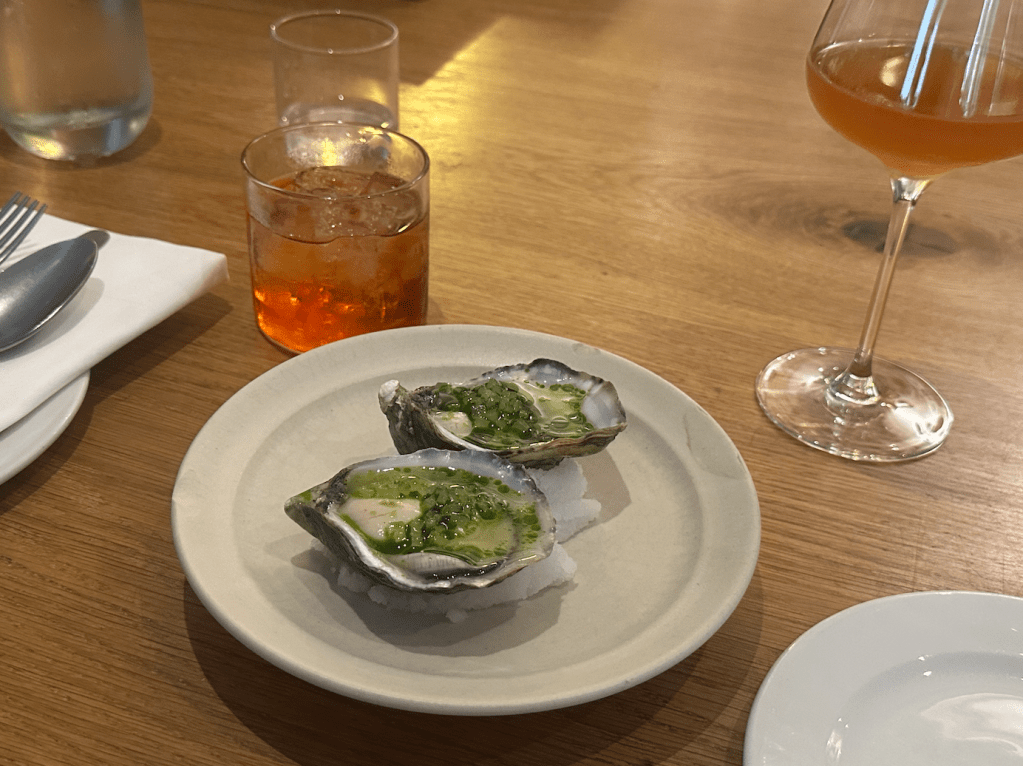
My lovely fellow diner and I started off cheeky with a chilly oyster dressed in cucumber and nam jim. A syllogism of contrast, this one-slurp-wonder bridged the salinity of sea to the vinegared green brightness of cucumber and the sharpened heat of nam jim. Crunch and slip. Walk with me here, next up – the bonito crudo with fire potato, crème fraîche and pili pili herb oil . The interplay of fat, acid, smoke and rawness was apex here. The fire potato – smouldering, softened – offset the slick precision of the crudo, while the herb oil added a botanical volatility. By now, you should understand that Freida is a coy girl, she knows restraint and provocation, balance and intention.
Continuing this throughline – a salad course of mizuna, yellow peach, cucumber, goat’s cheese and cashews. What this salad did was demonstrate the kitchen’s ability to modulate sweetness against vegetal bitterness.The mizuna, peppery and aloof, argues against cashew’s fatty warmth. In this dialogue of textures and tonalities, they are toxic ex lesbians that keep sleeping with each other.
For our shared main, the gnocchi with comté soubise and fresh summer truffle was…monumental. A small plate cutie, the comté lended a nutty, unctuous depth that folded into the silken onion soubise. The truffle added gravitas, sure, but honestly I didn’t even taste a thing. Obviously, the gnocchi was soft. I don’t think you need me to tell you that.
And finally, for dessert … oh my favourite … milk ice cream with strawberry jam and Norwegian brunøst cheese. A powerhouse. Our server (who was from Byron Bay!) said it reminded her of a Maccas strawberry sundae. For me, it tasted like strawberry cheesecake flavoured cereal. The shaved brunøst brought a wheaty, caramelised heft to the ruby-hued jam, while the milk ice cream well … uh tasted like milk (good job, Bee!).
Slowly creeping back to my nerd shit, I use my review of Café Frieda’s as a case study in what is urgently lacking in Sydney’s restaurant ecology: a daring, intellectually engaged and culturally sensitive approach to food as a mode of knowing and making.
Where Sydney’s higher-end dining scene is increasingly dominated by risk-averse hospitality conglomerates and reductive trends, Café Frieda’s offers a vision of food as edible theory and a practice of place. My admiration for a venue buds when I see that food is not just a commodity, but treated rightfully as epistemology.
In Berlin, this logic is embedded in the culinary scene – not just at Frieda’s, but at Ernst, at Lode & Stijn, at Otto. Each dish embodies unforced sophistication and a demonstrated rigour in intellectual hospitality, drawing from a distinctly European tradition of interpreting food as a cultural language. Cooking without collapsing into tired references or technique-driven spectacle.
This generosity of intent and ambition stands in contrast to much of Sydney’s dining culture, where innovation is unfortunately secondary to marketability, and the diner is cast as consumer rather than co-constitutive participant.
What, then, is stopping Sydney from fostering restaurants of this calibre and complexity?
Certainly not talent – Australia’s chefs are as capable and inventive as any. Nor is it access to ingredients – Australia’s biodiversity offers a staggering array of native flora and fauna still under-utilised in fine dining. Rather, the issue is structural: Sydney’s high-end dining landscape is increasingly dominated by vertically integrated hospitality groups whose business model suppresses risk, flattens creativity and rewards trend-following over taste-making. This environment has led to a deadening sameness across menus and venues.
Sydney’s restaurants reproduce a narrow canon of “innovative” ingredients – miso, yuzu, labneh, burrata – without genuine interrogation of place or process. What if I told you I actually don’t care about your house yuzu spritz. Or your miso caramel banana soft serve labubu matcha tiramisu. What if I shot you actually.
As a result, we are left with a dining scene obsessed with the performance of innovation.
The more insidious problem is cultural: in Sydney, chefs are too rarely afforded the status of thinkers. When I say the word “kitchen” – what comes to mind is labour, not creation. But to cook, seriously, is to compose, theorise, critique, kiss.
There are some exceptions – Bush in Redfern and The Waratah in Darlinghurst come to mind – where native ingredients are woven into the conceptual DNA of menus. Ingredients like wattleseed, myrtle, pepperberry and Davidson plum speak to histories and ecosystems too often ignored in Australian cuisine. These restaurants attempt something: food as repatriation, as cultural dialogue, as epistemic repair. But in most of Sydney, Indigenous ingredients remain under-researched, under-respected or entirely ignored. Instead, the city continues to digest international trends as a substitute for local flavour, absorbing global aesthetics while remaining disconnected from its own land.
So, Sydney doesn’t lack talent, it lacks courage. Sydney needs more culinary citizenship, which means going beyond “inspiration” and into genuine dialogue with country, culture and community. That’s how taste becomes knowledge.
It is here where Berlin’s potential as an instructive counter-model is most potent. Berlin – like Copenhagen, Lima and Bangkok – has emerged as a city of culinary imagination precisely because it treats food as a cultural act. Post-war and post-wall, it is a city that lives in a state of constant revision and cultural polyphony. Restaurants like Café Frieda’s succeed not only because they serve excellent food, but because they exist in a milieu that values hybridity and experimentalism. In these renowned food capitals, the restaurant is not merely a commercial unit but a discursive space.
Of course, there is an ethical dimension to this, too. For a cuisine to be of a place, it must engage with the history of that place. Europe has had time to reckon with its terroirs, its colonialisms, its borders and breaches. Berlin, in particular, cooks like this because it has inherited multiple pasts and is trying to taste them all at once.
The question is not whether Sydney can become a culinary capital. Something sung along with the likes of Berlin, Copenhagen, Lima and Bangkok. The question is whether Sydney is willing to dismantle the structures that currently suppress its potential.
Ok, now let me bombard you with rhetoricals. Are we overdue in unseating the dominance of hospitality groups that strip menus of idiosyncrasy and reduce chefs to brand custodians? Are we able to cultivate audiences willing to support slowness and thoughtfulness over novelty and volume? Idk. I hope so.
What Café Frieda offers is a blueprint. It’s a restaurant that is unafraid of emotional and gustatory complexity. Sydney is not lacking in potential. What it lacks is permission, and my experience at Café Frieda’s gives us a taste of what such permission might look like.
Whit, W. C., & Whipps, J. D. (2000). Food practice as epistemology. Journal for the Study of Food and Society, 4(2), 19–28. https://doi.org/10.2752/152897900786732790


 Very Busy Bee
Leave a reply to kentonmanhtran Cancel reply